Storm damage? We take emergency calls.(804) 489-7990
Ensure your safety with timely tree removals in Central Virginia. Learn when to act to protect your property and enhance curb appeal for peace of mind.
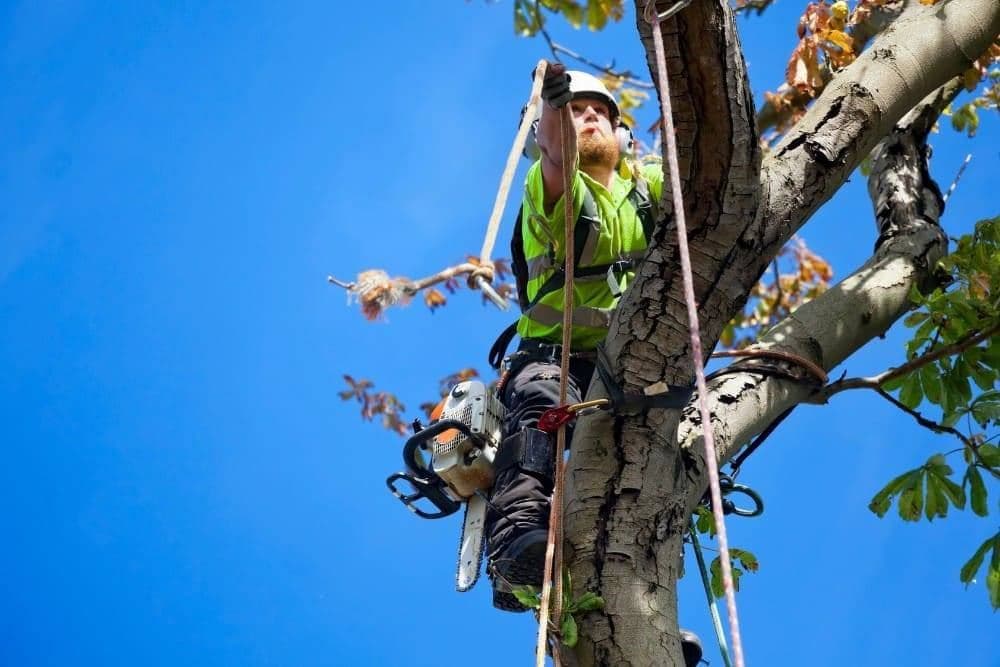
For homeowners in Central Virginia, trees are more than just landscaping. They are part of our heritage and property value. However, a dead or unstable tree is a significant liability. Whether it's an aging oak in Richmond or a storm-damaged pine in New Kent, knowing when a tree has crossed the line from "natural beauty" to "safety hazard" is critical for protecting your home and family.
This guide provides a professional framework for assessing tree health. We'll cover the specific red flags that indicate a tree is failing, the difference between what you can manage yourself versus when you need a certified arborist, and the unique environmental factors in our region that impact tree stability. For a more granular walkthrough, you can also refer to our step-by-step guide on assessing tree health.
A tree requires removal when its structural integrity is compromised beyond repair, posing an immediate risk to people or property.
Key Takeaways:
The most basic "rule of thumb" used by arborists is the 50% threshold. If a tree has lost more than half of its canopy or has sustained damage to more than 50% of its trunk circumference, its chances of long-term survival are slim.
In our experience serving the Richmond area since 2001, we've seen that trees exceeding this damage limit rarely recover their structural strength. While a tree might continue to produce green leaves for a few seasons, the internal "plumbing" is often too damaged to support the weight of the canopy during a high-wind event. This is particularly true for certain species; for instance, we are seeing a significant rise in Oak decline across Virginia, where once-sturdy trees are failing due to environmental stress.
Why it matters: A tree with 50% damage is in a state of "decline." As it dies, the wood becomes brittle. Brittle wood doesn't bend in the wind; it snaps. Removing a tree while it still has some structural integrity is much safer for the crew and less expensive for the homeowner than removing a "shattered" tree after a storm.
The trunk is the pillar of your tree's safety. Any compromise here should be treated as a priority.
Look for deep, vertical cracks that extend into the wood of the trunk. These are not just "bark deep." If you can see two parallel cracks on opposite sides of the tree, the tree is essentially split in two and could fail at any moment.
A hollow tree isn't always a dead tree, but it is a weakened one. If the "shell" of sound wood around a cavity is less than 30% of the tree's total diameter, the tree is structurally unsound. For example, a 30-inch diameter oak needs at least 9 inches of solid wood around a hollow center to remain stable.
Large, dead branches in the upper canopy are often called "widowmakers" for a reason. These branches can weigh several hundred pounds and fall without warning, even on a calm day. If you see branches with no bark or those that haven't produced leaves in two seasons, they need immediate attention.
Because roots are underground, they are the most overlooked part of tree safety. However, root failure is the leading cause of entire trees toppling over.
If you see "shelf" fungi or mushrooms growing directly out of the base of the trunk or on the ground near the root flare, it is a sign of internal rot. These fungi feed on decaying wood. By the time the mushrooms appear on the outside, the rot on the inside is often advanced.
A tree that has always leaned is usually not a problem, it grew that way to find light. However, a tree that starts to lean suddenly is an emergency. Look at the soil on the side opposite the lean. If the soil is cracked or "heaving" upward, the roots are physically pulling out of the ground.
Central Virginia Context: Our heavy clay soil can become saturated during wet springs. This "muck" provides very little "grip" for roots. If a tree is already weakened by rot, these saturated conditions are often the final straw that leads to a total fall. Understanding seasonal factors for tree removal can help you plan removals during periods when the ground is most stable.
What people do wrong: Ignoring a leaning tree or a large crack, hoping it will "heal" itself.
Why it's a problem: Trees do not heal; they "compartmentalize." A crack never knits back together. It only gets worse as the wood decays.
The right approach: Address structural issues the moment they are spotted. Early intervention might allow for expert tree trimming instead of a total removal.
What people do wrong: Cutting the entire top off a tree to make it "shorter" and "safer."
Why it's a problem: Topping creates massive wounds that the tree cannot close. It leads to rapid decay and the growth of "epicormic shoots", weak branches that break easily in the wind.
The right approach: Use "crown reduction" or "thinning" performed by a certified arborist to reduce wind resistance without destroying the tree's health.
What people do wrong: Choosing the lowest bid from someone without workers' comp or liability insurance.
Why it's a problem: If a worker is injured or a tree falls on your neighbor's roof, you are legally and financially liable if the contractor isn't insured. To avoid unexpected costs in tree removal, always verify insurance and get a detailed written estimate.
Deciding to remove a tree is never easy, but safety must come first. By identifying the 50% rule, checking for trunk cracks, and monitoring for root rot, you can make an informed decision before the next Central Virginia storm makes it for you.
Once the tree is down, you don't have to be left with an eyesore. There are many creative uses for tree stumps that can turn a removal into a landscape feature, or you can opt for professional stump grinding to clear the area completely.
Contact Conner Tree Service today for a professional tree health assessment.
Tree removal typically costs between $600 and $2,500 depending on the size, location, and complexity. A small pine in an open field is much cheaper than a 100-foot oak overhanging a house in Chesterfield. We provide exact, written quotes after a site visit.
In most of Central Virginia, permits are not required for private residential tree removal unless you are in a protected Chesapeake Bay Preservation Area (CBPA) or a historic district. Always check with your local county planning office in Henrico or Hanover if you are unsure.
Sometimes. If the issue is a pest or a specific disease caught early, treatments can work. However, if the issue is structural (like a split trunk) or advanced root rot, removal is usually the only safe option.
There is no set distance, but any tree that can strike the house if it falls is a potential risk. Large species like Silver Maples or Willows have "soft" wood and should generally be kept at least 20-30 feet away from foundations.
Removal can be done year-round. However, winter is often ideal because the ground is firmer (reducing lawn impact from equipment) and the lack of leaves makes the tree's structure easier to see.
Sources:
Serving Richmond, Quinton, Chesterfield, Henrico, New Kent, Hanover, Mechanicsville, and the surrounding Central Virginia area.
Free estimates, no obligation, and a straight answer about what the job actually needs.
