Storm damage? We take emergency calls.(804) 489-7990
Forestry mulching clears overgrown land in a single pass and leaves the material behind as mulch. No burn piles, no dump trucks, no bare scraped earth, just cleared ground with a protective layer already on it.
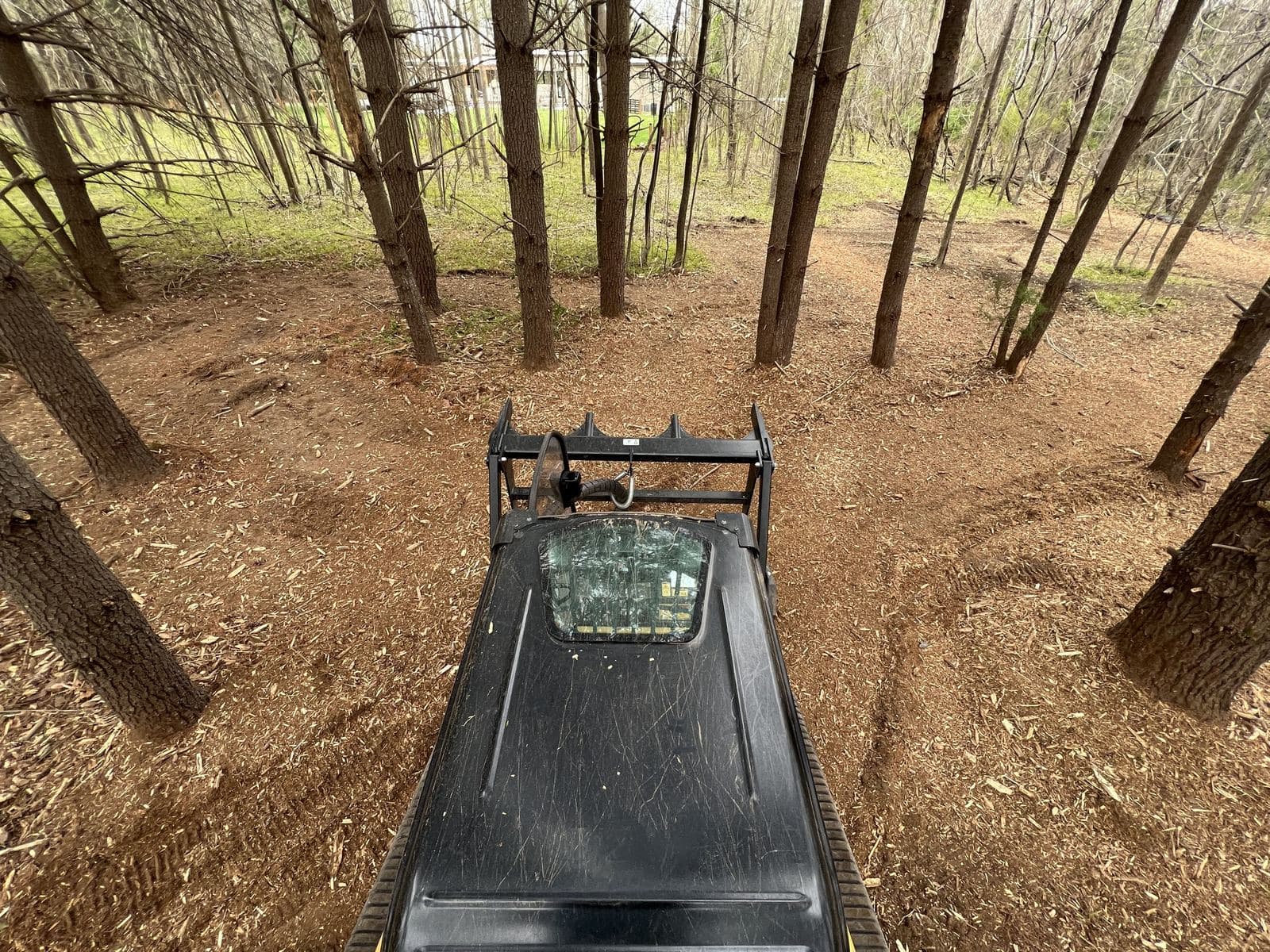
A mulching head mounted on a tracked carrier grinds standing brush, vines and small trees where they stand and spreads the result across the ground. What used to be three operations (cut, pile, haul) becomes one machine and one pass.
The mulch layer is the real advantage. It holds the soil against erosion, suppresses the regrowth that would otherwise come straight back, retains moisture, and breaks down into the soil over the following seasons. Conventional clearing gives you bare dirt and a weed problem next spring.
Because there's no burning and no hauling, mulching is usually permitted where open burning isn't, and it's far gentler on the site: low ground pressure tracks, no grubbing, and root systems left intact to hold the ground together.
Cutting, processing and clean-up happen together, which keeps the cost per acre well below conventional clearing.
The mulch layer protects bare soil through the first rains and suppresses the regrowth that follows scraped clearing.
Nothing leaves the site and nothing goes up in smoke, which also means no burn permit and no dump fees.
It's the right tool for a lot of jobs, but not every one. Here's where it shines.
Land that's been left to itself for a few years (brush, briars, vines and saplings) is exactly what a mulching head is built for.
Cutting a riding trail, a shooting lane or a wildlife plot through wooded ground, leaving the mature trees and the soil structure intact.
Reclaiming a fence line swallowed by brush, or opening up a property boundary that's disappeared into the treeline.
Clearing a house site, a driveway route or a utility run ahead of the excavator, without the burn piles and haul-off.
Knocking back autumn olive, multiflora rose, privet and the like across an area too large to cut by hand.
Hazardous, diseased or simply unwanted trees taken down safely: by climb, bucket truck, crane or off-road lift.
Learn morePruning that improves a tree's structure and health: deadwooding, thinning, lifting, reduction and pollarding.
Learn moreGrinding stumps below grade so you can seed, plant or pave: no regrowth, no trip hazard, no eyesore.
Learn moreHeavy-duty rotary cutting for fields, pastures and overgrown lots, priced by the acre.
Learn moreEmergency response for trees on houses, across driveways and into lines, day or night.
Learn moreFree estimates, no obligation, and a straight answer about what the job actually needs.
