Storm damage? We take emergency calls.(804) 489-7990
Good pruning is invisible. Done right, a trimmed tree just looks like a healthier version of itself: better structure, more light underneath, and far less chance of a limb ending up on your roof.
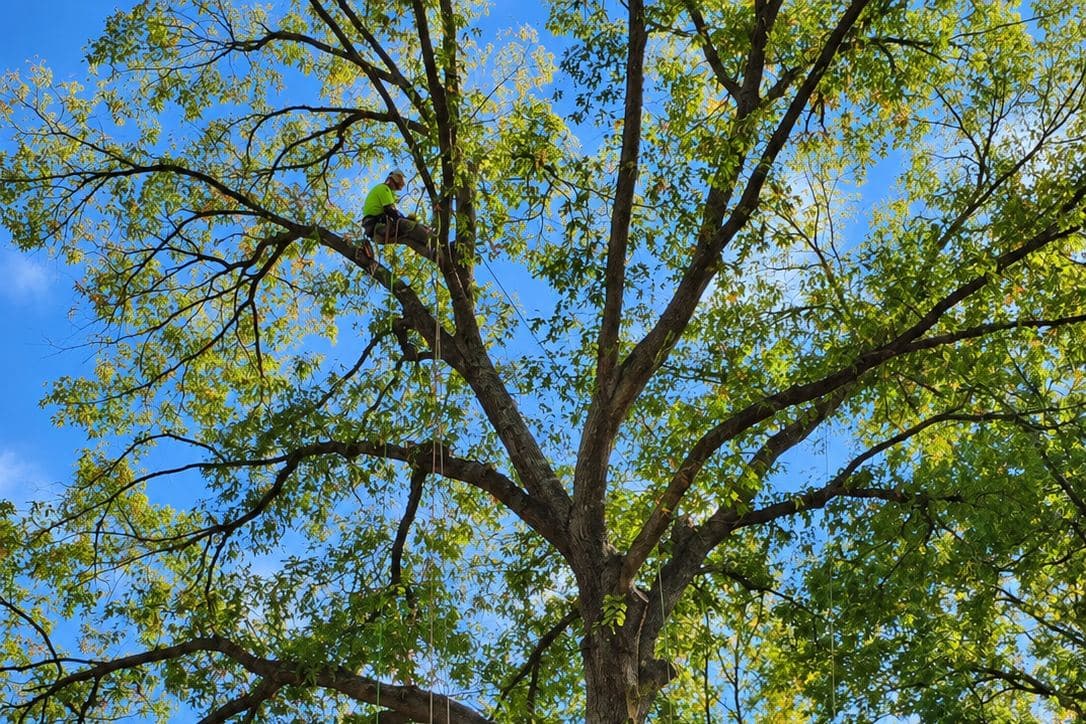
Most tree failures are predictable. Deadwood that was never cleared, a co-dominant stem with included bark, a crown so dense it acts like a sail in a thunderstorm. These are visible years before they become a problem, and each of them has a straightforward pruning answer.
We assess each tree individually rather than working to a formula. Species, age, site, and what you actually want from the tree all change the right cut. Over-pruning is as damaging as neglect, and topping a tree is something we won't do.
Timing matters in Virginia. Most hardwoods are best pruned in late dormancy, oaks are safest outside of the spring oak-wilt window, and storm-damaged limbs come off whenever they happen. We'll tell you if waiting a few months gets you a better result.
Clearing deadwood and opening the canopy improves airflow and light, which reduces fungal disease and encourages sound growth.
Weak unions, hanging limbs and branches growing into the roof or the service drop get dealt with before the next storm finds them.
A well-shaped canopy and a lifted crown make a yard feel bigger, brighter and deliberately cared for.
"Trimming" covers several quite different operations. Which one your tree needs depends on its species, structure and the problem you're trying to solve.
Removing dead, dying and diseased branches. It's the highest-value cut on almost any mature tree: it eliminates the limbs most likely to drop, and it doesn't stress the tree because the wood is already gone.
Selectively taking out interior branches to reduce density without changing the tree's size or shape. More light and air move through, and the canopy catches less wind in a storm.
Removing the lowest branches to raise the canopy: clearance over a driveway, a walkway, a roofline, or simply enough headroom to mow and use the space underneath.
Shortening the outer canopy back to sound lateral growth to reduce a tree's overall size while keeping its natural form. This is the correct alternative to topping, which creates weak regrowth and long-term decay.
A repeated cycle of cutting back to established points, started while a tree is young. It keeps a large species to a set size in a confined spot, but once begun it has to be maintained on schedule.
Hazardous, diseased or simply unwanted trees taken down safely: by climb, bucket truck, crane or off-road lift.
Learn moreGrinding stumps below grade so you can seed, plant or pave: no regrowth, no trip hazard, no eyesore.
Learn moreOne-pass land clearing that turns brush and small trees into mulch left on site: no burn piles, no hauling.
Learn moreHeavy-duty rotary cutting for fields, pastures and overgrown lots, priced by the acre.
Learn moreEmergency response for trees on houses, across driveways and into lines, day or night.
Learn moreFree estimates, no obligation, and a straight answer about what the job actually needs.
