Storm damage? We take emergency calls.(804) 489-7990
When a tree threatens your house, your power lines or the people under it, taking it down is a job for people who do it every week. We remove trees of every size across Central Virginia, and leave your yard looking like we were never there.
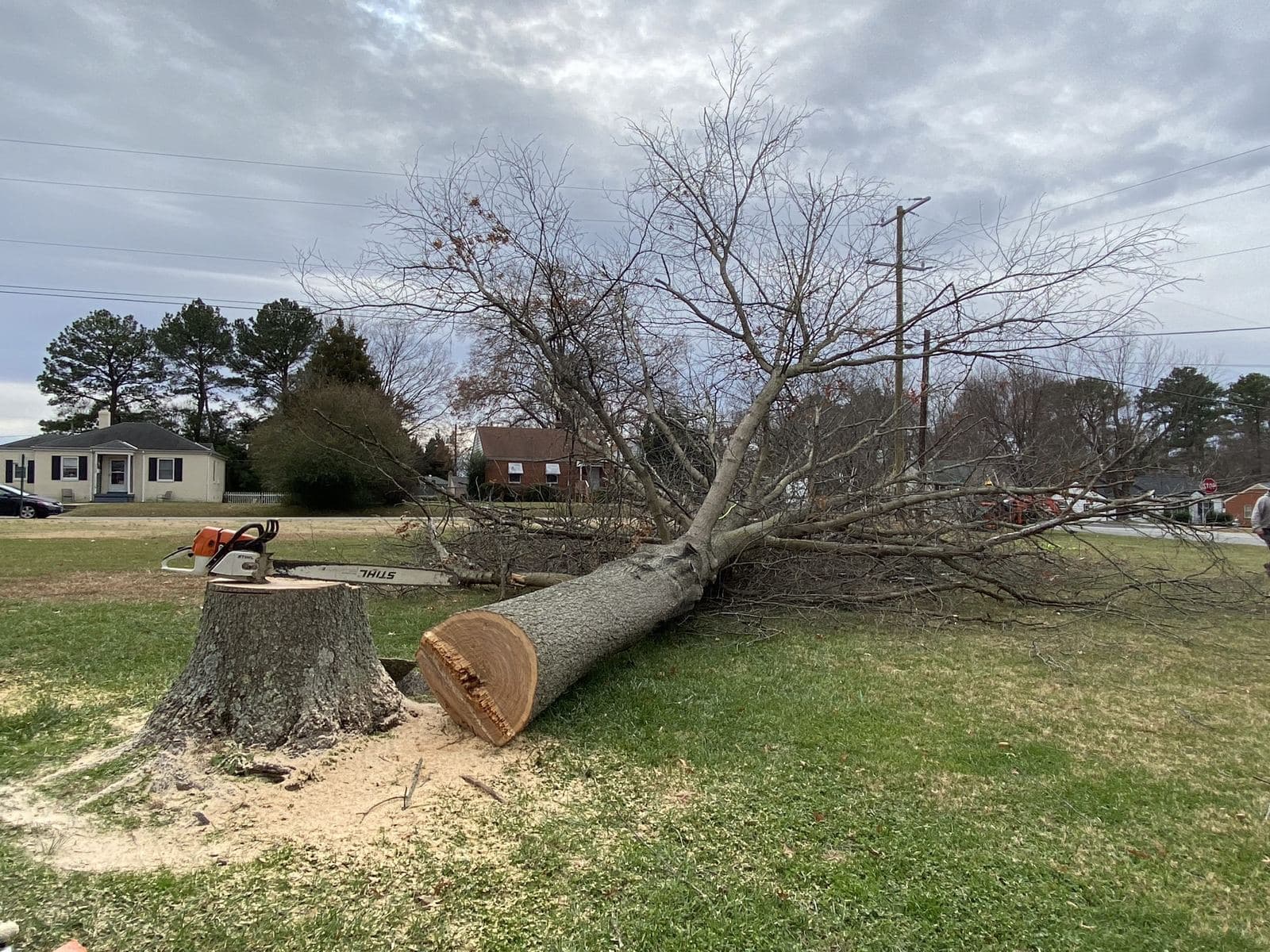
Trees are worth keeping right up until they aren't. Roots lifting a foundation, a leader growing into the service drop, a trunk hollowed out by decay, a canopy leaning over the roofline after a wet spring. Any one of those turns an asset into a liability. Fungal disease, borer damage and storm-weakened limbs all move faster than most homeowners expect.
We handle everything from a single backyard pine to large-scale commercial clearing. Our crews work to current arboriculture standards, and we carry both liability and workers' compensation coverage, so the risk of the job stays with us rather than with your homeowner's policy.
Protecting the ground matters as much as dropping the tree. We run an off-road lift on turf tires and lay plywood paths or yard mats on soft ground, so the usual aftermath (rutted lawn, cracked walkway, flattened beds) doesn't happen. Most customers tell us the only thing they notice afterward is the missing tree.
Every job ends with a walk-through. If something isn't right, we fix it before we load up.
Liability and workers' compensation coverage that meets state and federal contractor requirements.
Crane, bucket truck and turf-tire off-road lift, so tight and technical removals don't become destructive ones.
Plywood paths and yard mats on soft ground, full debris haul-off, and a walk-through before we leave.
There's more than one way to take a tree down, and picking the wrong one is how property gets damaged. Here are the five approaches we use, and when each makes sense.
When a tree is a manageable size with a clear drop zone, we fell it whole. Low limbs come off first so nothing catches on the way down, then we cut a directional notch, make the back cut, and set wedges to control the fall.
Close to a house, a road or a power line, a tree has to come down in pieces. A climber ascends on ropes and spurs, ties in, and takes the crown apart limb by limb, lowering or dropping each piece into a controlled pile.
For tall or brittle trees that aren't safe to climb, and for anything grown up around a service line, a bucket truck lets us work methodically through the canopy from a stable platform.
A crane lifts sections out over the obstacle instead of through it. It's the safest option for a badly decayed tree, a tight courtyard, or anything hanging over a roof.
Our turf-tire lift reaches the back of a property where a bucket truck or crane can't go, without tearing up the ground getting there, and without putting a climber in a tree that shouldn't hold one.
Pruning that improves a tree's structure and health: deadwooding, thinning, lifting, reduction and pollarding.
Learn moreGrinding stumps below grade so you can seed, plant or pave: no regrowth, no trip hazard, no eyesore.
Learn moreOne-pass land clearing that turns brush and small trees into mulch left on site: no burn piles, no hauling.
Learn moreHeavy-duty rotary cutting for fields, pastures and overgrown lots, priced by the acre.
Learn moreEmergency response for trees on houses, across driveways and into lines, day or night.
Learn moreFree estimates, no obligation, and a straight answer about what the job actually needs.
